Inside the Launchpad: What happens before you commit to building

6 weeks of asking hard questions can save you 6 months of building the wrong thing. Here's what actually happens inside a Launchpad and what you walk away with before you commit to full-scale development.
TL;DR | |
What is Launchpad? | VITech's discovery phase, which bundles strategy and execution into a six-week sprint. |
What do you get at the end? | A Blueprint report, a codebase/infrastructure health check, a path-to-revenue plan, and a working pilot. |
What problem does it solve? | Validate the business case, uncover technical risks, challenge assumptions, and define what should actually be built. |
Does the process improve over time? | Every Launchpad feeds into a retrospective, which has produced changes such as kanban-tracked deliverables, mandatory Ignition options, and a required path-to-revenue section. |
"Solid on paper" and "solid in practice" are two different things. And the gap between them is where products get expensive.
Every founder reaches the same moment: the plan looks good, the budget's approved, and it's time to build. But scope has a way of doubling once a team actually opens the codebase, and a deadline someone mentioned in passing has a way of becoming a hard deadline nobody actually agreed to.
None of this shows up in a pitch deck. It shows up three weeks into a build, when changing course costs real money.
That's the gap Launchpad is built to close. In six weeks, you get clarity on what to build, what could go wrong, and what it will take to move forward before committing to a long-term engagement. We’ll tell you how in this blog.
What Launchpad actually is
Launchpad is VITech's six-week engagement that turns uncertainty into a delivery plan. It’s a path from "here's our idea" to "here's exactly what we're building and why." Unlike a discovery phase focused primarily on requirements and estimates, Launchpad connects product strategy, technical validation, commercial viability, and an execution-ready path forward.
During Launchpad, we:
validate business assumptions,
assess what's actually in the codebase or what needs to be built from scratch,
identify risks,
define the product architecture,
prioritize the fastest path to business value.
We built Launchpad after watching the same problem repeat: a client and a vendor agree on a rough direction, start building, and only later realize they'd been picturing two different products the whole time. By then, there's a team on the clock and a budget shrinking. Launchpad catches that mismatch in week two.
What happens during the six weeks
Preparation
Before the engagement begins, we pull together everything already known about your product: existing documentation, any prior vendor work, and the client's own notes on what they're trying to build. This is where the team starts forming questions.
Kickoff
The first real session. This is also where VITech shows its hand early, walking through a few ideas about the product before any contract details are locked in. Not polished recommendations, just informed instincts. It's our chance to show you we have clearly done our homework before being asked to.
Week 1–2: Blueprint
The core of Launchpad. Four things happen here:
Business alignment | Making sure everyone actually agrees on what "success" means for this product. |
Technical assessment | Opening up the codebase (existing or planned) and finding out what's really there. |
Opportunity mapping | Identifying where the real product opportunity sits, sometimes in a different place than the client initially assumed. |
Path to revenue | Working backward from "what needs to be true for this to make money" instead of forward from "what could we build". |
Reflection week
Rather than rushing straight from planning into implementation, both teams take time to review the Blueprint, discuss recommendations, and choose the best direction forward. Here, we catch half-formed plans before they turn into commitments.
Week 3–6: Ignition
With the direction confirmed, we turn strategy into an execution-ready plan. We define the solution architecture, prioritize the roadmap, estimate different implementation options, and prepare everything needed for delivery.
By the end of Launchpad, there are no major unknowns left. You have a validated product direction and a realistic implementation plan.

What the client walks away with
By the end of Launchpad, you have a better understanding of your product and everything needed to make an informed decision about what comes next.
Deliverable | What it’s for |
Blueprint Report | A practical guide to what to build, why it matters, and how to execute it successfully. |
Value-driver map | A visual framework built around business value and the shortest path to revenue. |
Scoped set of options | Two or three concrete paths forward, each priced, scoped, and tied to what actually needs to exist before launch. |
Health check | An honest read on any existing code and infrastructure: what's solid, what needs work, and what's a risk worth knowing about now. |
Path to revenue | The plan that answers the harder question: what's the shortest route to proving this thing can make money? |
Knowledge playbook | Full documentation covering the architecture, infrastructure, third-party services, deployment process, environments, credentials management, and key technical decisions. |
Pilot | A working proof of the chosen direction. Instead of a theoretical plan, you leave with software that validates key assumptions and provides a foundation for future development. |
Whether you choose to continue with VITech or not, you leave with the knowledge and documentation needed to move forward confidently.
How Launchpad keeps getting sharper
Every Launchpad ends with a retrospective. Sometimes there is more than one, with a full room of people who worked the engagement going through what worked and what didn't. One particularly difficult Launchpad generated three separate sessions and pulled in around ten people across the company.
That habit has actually changed how Launchpad runs. A few concrete examples:
What a retrospective surfaced | What changed as a result |
Small tasks (signing documents, building presentations, cost sections) occasionally slipped through the cracks on fast-moving projects | A standardized Kanban board now tracks every task, with a Delivery Manager accountable for moving each one forward |
Teams committed to more scope than a six-week engagement could reasonably absorb | Blueprint now ends with mandatory Ignition options (A/B/C) instead of a single plan to accept |
Good products stalled without a clear route to commercial validation | Path to Revenue is now a required section in every Blueprint |
None of this is about pretending every engagement runs smoothly. It's the opposite, treating every rough one as information the next client benefits from. Which means the Launchpad you go through has already been improved by every engagement that came before yours.
The lessons that changed Launchpad
After each engagement, the team reviews what challenged us, what created the most value for the client, and what should become part of the methodology. Some lessons refine the process. Others fundamentally change it.
Lesson #1: Great partnerships start by challenging assumptions
Every Launchpad kickoff has a moment we internally call the "Secret Sauce"—a handful of early ideas about the client's product.
The situation
A client is building a functional medicine app that gets health recommendations based on what wearable devices track. The client assumed wearable integrations alone would eat months of development time, given how many brands are out there, like Garmin, Samsung, Apple Watch, Whoop, and the rest.
The move
We proposed skipping individual integrations entirely and connecting through a single data aggregator, Terra, that already speaks to most major wearables through one interface. One connection instead of dozens.
Insight
Clients don't remember the vendor who agreed with everything they walked in with. They remember the one who said, "actually, there's a cheaper way to do this," and was right.
Lesson #2: Uncovering hidden risks
Not every Launchpad starts with a blank slate.
The situation
A sports analytics client came to us with an existing codebase built by a previous vendor. The plan: review it, find the gaps, move forward.
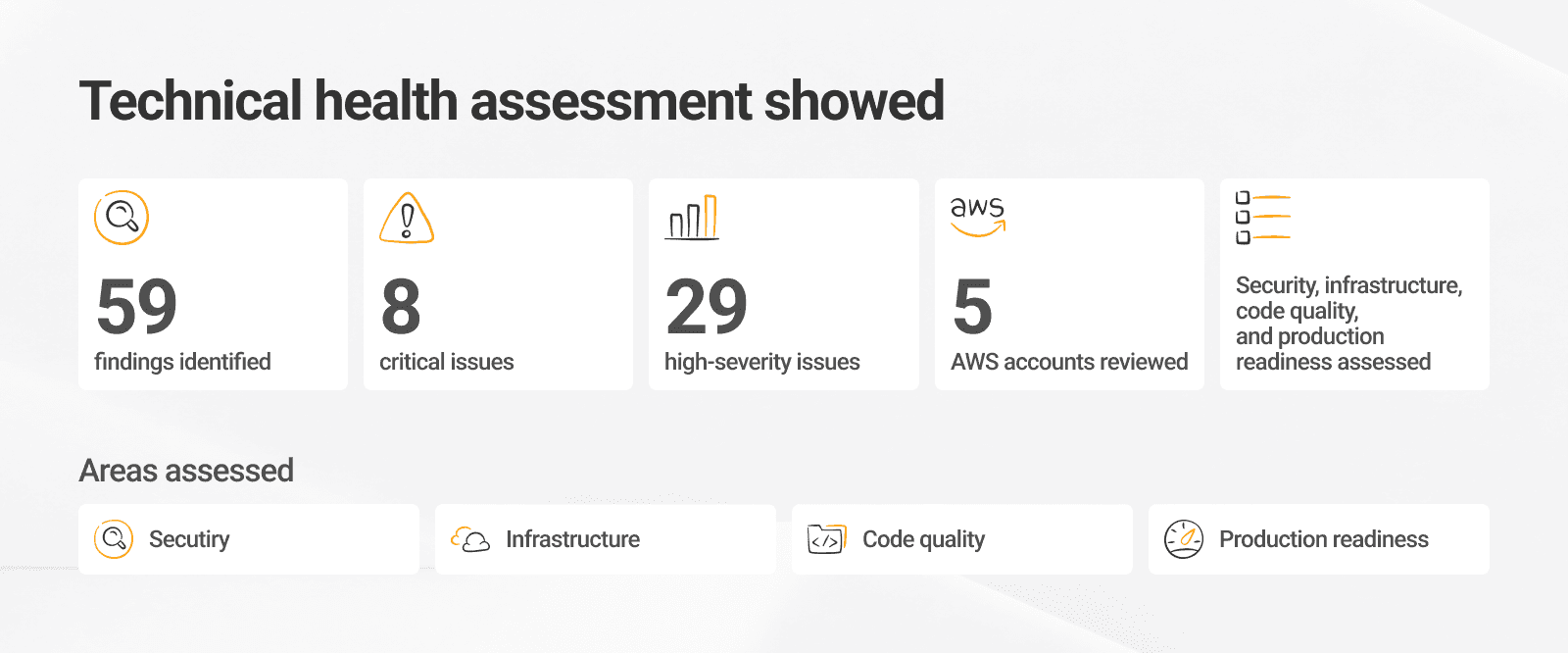
Discovery one
A week into discovery, we realized we'd been looking at the wrong repository. The previous vendor had kept a separate, unofficial version nobody knew existed. Everything had to be reviewed again.
Discovery two
The second discovery came from the infrastructure itself. A full security and standards review turned up enough problems that the team couldn't move forward without fixing them first.
Insight
A discovery phase that only confirms what a client already believes isn't doing its job. The real value shows up when it finds the problems nobody knew to ask about.
Lesson #3: Priorities create products
Every client wants everything.
The situation
That same sports analytics client had a clear vision, real momentum from an inherited codebase, and what felt like firm deadlines. The team, eager to deliver, said yes to nearly all of it.
What happened
The deadlines turned out to be flexible but not before the team had already committed to a pace it couldn't sustain. Scope kept expanding to match what the client wanted, rather than what the product actually needed to launch.
Insight
Not every feature a client wants is a feature the launch needs. Figuring out which is which, before the building starts, is the job.
Lesson #4: Follow the path to revenue
Most product plans start with a feature list and work outward. Launchpad flips that.
The situation
The same sports analytics client, once again chasing an ever-growing feature list.
The move
Instead of asking "what could we build," the better question is "what's the fastest way to prove this makes money," and then building only what that requires.
The result
Fewer features, tighter scope, a real launch date instead of an aspirational one.
Insight
A great feature list means nothing without a fast way to prove the business works. Path to revenue is the filter everything else has to pass through first.
Key takeaways
Here's what six weeks of Launchpad actually buys you:
A tested plan. Assumptions about scope, timeline, and technical reality get checked before anyone commits real budget to building.
Real choices. Every Blueprint ends with scoped options, so you decide deliberately instead of a team just saying yes to everything.
Risks found in week two. Inherited code, infrastructure issues, hidden technical debt: the things that normally surface halfway through a build get caught while they're still cheap to fix.
A path to revenue. The plan answers what it takes to prove the business works.
A process that keeps improving. Every Launchpad feeds a retrospective, and every retrospective changes how the next one runs.
There's a real difference between a vendor who starts executing tickets on day one and a partner who spends six weeks making sure those tickets are the right ones. The first one moves fast, and the second one protects your runway.
Thinking about building or rebuilding your product? Reach out to us, and we’ll tell you more about what your tailored Launchpad will look like.
FAQ
Do we have to continue working with VITech after Launchpad?
No. You can walk away with a scoped plan you can take anywhere.
What if we already have an existing codebase from another vendor?
We review it during Blueprint as part of the technical assessment. That's exactly what this phase is for.
What do you deliver at the end of Launchpad?
A Blueprint report, a pilot, scoped Ignition options, a value-driver map, a codebase and infrastructure health check, and a path to revenue.
Why not start development immediately?
Because building on an untested plan usually costs more than testing the plan first.
What happens if our priorities change halfway through?
Blueprint gives you multiple paths forward. So, a shift in priorities usually means picking a different option, but not starting over.
What if the Launchpad reveals more work than we expected?
We'd rather flag that in week two than in month two. Every issue found gets scoped and priced before it becomes a surprise later.

Share post